The 18 Best Startup Books for Founders in 2026

Running a startup isn’t easy. I know a thing or two about this.
It’s a high-risk, high-reward venture, and having a great idea for a product isn’t enough on its own to guarantee success. Actually, the idea is very often one of the most important things: execution is king, and even successful entrepreneurs can fail.
There are a lot of moving pieces to build a successful startup:
Testing business ideas. Prototype development. Market research. Competitor analysis. Funding. Beta testing. GTM launch strategies. Hiring staff and contractors. Branding. Customer experience. Sales.
The list is endless and can be overwhelming, especially for first-time founders. It’s no surprise most startups fail.
Over the years since starting AdEspresso, I’ve read hundreds of startup books ranging from business to product, marketing, fundraising, and anything you can think of. Likely, my co-founder has an even larger reading list.
The 18 best startup books at a glance
Short on time? Here’s every book on this list, who it’s for, and the one-line reason it’s here. Full reviews below.
| Book | Best for | In one line |
|---|---|---|
| Lost and Founder | Founders | The honest emotional reality of the startup journey. |
| Zero to One | Founders | Peter Thiel on building something genuinely new. |
| The Mom Test | Customer discovery | How to talk to customers without being lied to. |
| The Lean Startup | Early-stage | Build-measure-learn and validated learning. |
| The Hard Thing About Hard Things | CEOs | The brutal decisions nobody prepares you for. |
| Build | Product & hardware | Tony Fadell’s guide to making things worth making. |
| Who | Hiring | The A-method for hiring the right people. |
| Founders at Work | Aspiring founders | Early-days war stories from famous startups. |
| Hooked | Product | Building habit-forming products. |
| The Cold Start Problem | Network-effect startups | Getting your first users and scaling network effects. |
| Working Backwards | Operators | Amazon’s operating model (PR/FAQ, six-pagers). |
| The Startup Owner’s Manual | Early-stage | The step-by-step customer-development bible. |
| The $100 Startup | Bootstrappers | Start lean, on almost no money. |
| Predictable Revenue | Sales | The Salesforce outbound sales playbook. |
| From Impossible to Inevitable | SaaS growth | The seven levers of hypergrowth. |
| Buy Back Your Time | Scaling founders | Delegate ruthlessly and reclaim your time. |
| Co-Intelligence | AI-era founders | How to work with AI as a coworker, not an oracle. |
| Incorruptible | Long-term builders | Why good companies go bad, and how to stay great. |
Are Startup books worth your time?
Here’s the harsh truth: Most startup books suck. Some are good. Some are great.
Yet, no matter how many startup advice you read… the best learnings will come from actually getting your hands dirty, getting customer feedback, playing the vc game, and a lot of trial and error.
You’ll build (I hope) a successful startup with a lot of stress and sweat. Not comfortably reading books on your couch.
That said… there are great books that can help you avoid some errors and common pitfalls most aspiring entrepreneurs encounter in their startup journey.
Since you’ll soon discover your most scarce resource as a startup founder is time, I’ve put together a list of the best startup books every founder should read, in my very personal opinion.
I know, I know … there are hundreds of “best startup books collection” posts out there… so why mine? Well… I’ve read most of them, I’ve founded 2 successful startups and invested in many others, and some of these links might be affiliate, which means I’ll earn a few cents if you buy the book… don’t worry, it doesn’t affect the quality of the selection. Amazon has all the books anyway ;)
Alright, that’s enough of an intro, let’s jump right into this list of the best startup books you can read in 2026.
PS: I’ll add books to this list as I read them to keep it always fresh. The last update is from July 2026.
Lost and Founder: A Painfully Honest Field Guide to the Startup World

Rand Fishkin’s Lost and Founder is a masterpiece when it comes to business and startup books. It truly is “painfully honest” in a way very few resources or entrepreneurs in the startup world ever are.
Fishkin (well-known previous CEO at Moz and currently working on SparkToro) details his very significant ups and downs as an entrepreneur. He talks about how it took fifteen long years to grow both his business and his personal reputation after he got his start leading a mother-and-son business that was deeply in debt.
He’s blunt about the very high highs and the very low lows of startup life, including seemingly devastating facts like how sometimes the wrong time for launch can destroy any potential growth, or how venture capitalism can have its own significant pitfalls.
Fishkin hasn’t just talked the talk, he’s really walked the walk, and this book walks you through everything that he’s learned at every stage of startup ownership. You’ll walk away having learned some seriously valuable lessons, you’ll know some critical mistakes to avoid making, and you may feel a little less alone with potential perceived failures you’ve already experienced.
I’m glad even Russel Brunson recently shared it with his audience.

Overall, this is probably the only book in the list that is not technically a guide and more a “biography.” It’s also the most realistic representation of the entrepreneurial journey many founders go through. They don’t teach these things at business schools. This is the book I recommend to everyone, and for me it deserves the #1 spot in every top startup books’ list.
The only part where I kinda disagree with Rand is when he talks about venture capital. He is very averse to it. I don’t disagree, and I see where that’s coming from. But maybe he’s a bit too trenchant. Venture deals are not bad per se… they come with strings attached, and you simply need to be very aware of them.
Pages: 320
Price: $14.99
Year: 2018
Get on Amazon
Zero to One: Notes on Startups, or How to Build the Future

Zero to One, written by Paypal co-founder Peter Thiel with Blake Masters, this book is all about innovative thinking.
Even in their book summary, they make the point that “doing what someone else already knows how to do takes the world from 1 to n, adding more of something familiar.”
It’s hard to argue with that.
Instead, they argue that using creative and innovative thinking is important to break the mold and offer something new. This book discusses valuable tactics that will help you break free of “uninspired thinking” by asking specific questions to help you discover untapped value in places you may not have expected.
And as a plus, the writing is sharp, to the point, and fluff-free. As a writer who sometimes finds business books a little painful to read, this is one I can happily recommend for the writing, too.
That said, not every startup needs to become a unicorn or work on incredible breakthroughs for humanity. If that’s your appetite… wonderful, go for it. But it’s not for everyone. And often smart, controversial people like Peter Thiel forget about it.
It’s totally okay to build a better solution to a problem you experience firsthand every day. Sure, you won’t change the world but you’ll have more fun and will be more likely to succeed.
Pages: 213
Price: $13.99
Year: 2014
Get on Amazon
The Mom Test: How to Talk to Customers & Learn if Your Business Is a Good Idea When Everyone Is Lying to You
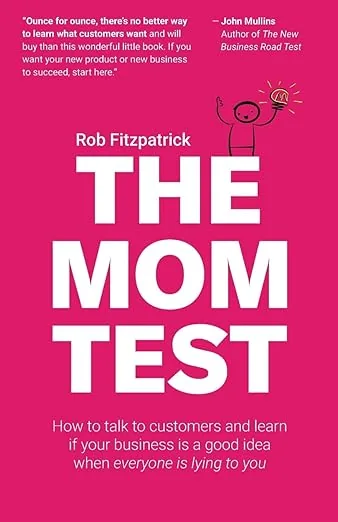
If there’s one book I wish I’d read before writing a single line of code for my first startup, it’s this one.
Rob Fitzpatrick’s The Mom Test is about the one skill nobody teaches you and everybody gets wrong: talking to customers. The premise is brutal and true. If you ask people whether they like your idea, they’ll lie to you. Not out of malice… your mom would tell you your idea is great because she loves you. Everyone else does a softer version of the same thing.
The fix is to stop pitching and start asking about their life. Talk about what they actually do today, what it costs them, what they’ve already tried. Opinions lie. Past behavior doesn’t. Fitzpatrick turns that into a handful of dead-simple rules you can use in your next customer call.
It’s also the shortest book on this list by far. You can read it in an afternoon, and it’ll save you months of building something nobody wants. That’s about the best return on reading time a founder can get. It’s taught at Harvard and MIT for a reason.
Pages: 136
Price: $17.83
Year: 2013
Get on Amazon
Lean Startup

Author Eric Ries has an entire “Lean” series of books, but The Lean Startup is the one that we think every startup founder needs to read.
“Lean” here refers to the idea of sticking more to the basics to maximize efficiency. This includes leveraging your capital more efficiently to stretch every dollar as far as it can go, and to leverage your manpower and creativity to the max.
By keeping your business lean, Ries argues, you’ve got more room to maneuver, giving you greater agility to shift as you need to (and let’s be real— startups often need to pivot regularly to at least some degree).
In the end, most startups immediately achieve explosive customer growth… this doesn’t mean that by using a lean startup methodology, you could still build a successful business in the long run.
This book does go beyond theory; it also goes into detail about how entrepreneurs can test their vision for the company on an ongoing basis so they can alter course before it’s too late to do so (or even just too expensive).
Some of his recommended practices may seem counter-intuitive, but they focus on real progress— not vanity metrics— and finding what the market wants so you can deliver it.
You should read this book from the get-go before you write the first line of code for your minimum viable product. For sure, it’s one of the best startup books out there.
Pages: 334
Price: $9.99
Year: 2011
Get on Amazon
The Hard Thing About Hard Things: Building a Business When There Are No Easy Answers

Even the title of The Hard Things written by Ben Horowitz (who is a well-known VC in Silicon Valley) is extraordinarily relatable to most startup founders because it often truly feels like there are only hard choices to make— and so many of them.
The core priority of this book is to share practical wisdom about getting through some of the most difficult and real problems you’ll face in the startup world.
Ever thought about the predicament of needing to fire a friend? Do you know how to poach top talent from direct competitors? These are just two examples of the many hard things every founder of a successful startup founder has to do. By the way, my personal startup advice here is not to hire friends in the first place :)
Business ownership can be lonely and frustrating, but this startup book can help you feel better and more prepared for some of the hardest challenges you may have to face. It’s a fun and easy read; there’s some great humor, and Ben Horowitz even includes some rap lyrics to drive home his point while sharing his real-life experiences and the lessons he’s learned along the way.
Finally, it’s always useful for a startup founder to read how venture capitalists think about startups.
Pages: 308
Price: $18.49
Year: 2014
Get on Amazon
Build: An Unorthodox Guide to Making Things Worth Making
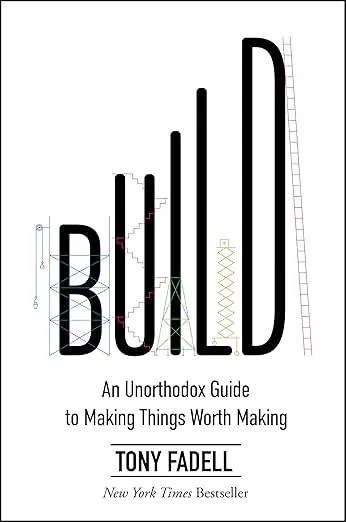
Tony Fadell built the iPod, then the iPhone, then the Nest thermostat. So when he writes a book called Build, you shut up and read it.
What I love is that it’s not a memoir. It’s structured as advice you can actually use, organized roughly around a career arc. How to pick what to work on, how to build a product people love, how to be managed and then how to manage, how to hire, when to raise money, and when to walk away. Each chapter is short and opinionated, the way good advice from someone who’s done it usually is.
Fadell comes from a hardware background, so a few examples are very Apple-and-atoms rather than SaaS-and-bits. Don’t let that put you off. The chapters on product, mentorship, and building teams are as useful to a software founder as to anyone bending metal.
If Lost and Founder is the honest emotional side of building a company, Build is the craftsman’s side. Both belong on the shelf.
Pages: 416
Price: $19.26
Year: 2022
Get on Amazon
Who

Who— written by Geoff Smart and Randy Street— is centered around the fact that so many small businesses make a crucial error. They focus on what they’re selling or what problem they’re solving and forget about the who.
Who have you hired? You can save millions by avoiding costly hiring mistakes, and this book is all about that.
They include:
- A 4-step method for hiring the right team members with what they say is a 90% success rate
- The promise of potentially saving $1.5M by avoiding basic hiring mistakes
- Interviews with over 20 billionaires and 60 different high-profile thought leaders, including CEOs and investors (which originally comprised of over 1300 hours of interview materials)
The book is well-written and concise, and has two authors that have multiple decades of relevant experience (and success) each. This is one hiring guide startup owners should read right away.
Trust this might sound boring, especially at the beginning when you’re a one-man band, but I can assure you as you scale your startup and start shaping your startup culture, hiring the wrong people can have a devastating impact, even kill your company.
Pages: 208
Price: $9.99
Year: 2008
Get on Amazon
Founders at Work: Stories of Startups’ Early Days

Jessica Livingston’s Founders at Work is an exceptional compilation of interviews where founders of downright famous tech companies discuss their earliest days with their companies.
Steven Wozniak from Apple. Max Levchin from PayPal. Caterina Fake from Flickr. Sabeer Bhatia from Hotmail.
They share their stories about how they learned to build their now-famous companies, including how they got the idea for their businesses, won over investors, and recovered when plans went sideways.
What’s unique about this book compared to many others is that the interviews are the entire focus of the book. They’re in-depth and from various sources; it’s not just one founder’s story, and it’s not just a few quotes from experts that are dropped in to prove someone else’s point.
You’ve got diverse experiences, all leading to incredible success. That’s worth reading and listing among the best startup books!
By the way, the author, Jessica Livingston, is also a co-founder of world-renowned startup accelerator Y-Combinator! She has probably seen and interviewed more startups than anyone else.
The only downside of the book is that all interviews are about successful businesses. You only get the bright side of the startup world; sometimes, these founders tend to have a point of view that is too skewed toward the “change the world” approach.
Pages: 457
Price: $9.99
Year: 2008
Get on Amazon
Hooked: How to Build Habit-Forming Products

Any product can have a solid GTM strategy, good timing, and a little bit of luck that results in a successful launch.
But what about long-term retention? That’s something else entirely.
A big part of high retention rates comes down to habit. When someone uses your product as part of their established routine and it’s a true habit, your value goes up.
Hooked, by Nir Eyal, is all about how you can create habit-worthy products through “hook cycles” that keep users coming back over and over, all while you spend most of your marketing budget on initial customer acquisition.
Learn about Eyal’s Hook Model, which is a four-step process that many successful companies use (knowingly or not) to drive repetitive customer behavior. This book is actionable, and it also includes outstanding examples that help you understand the core points and lessons.
Pages: 256
Price: $16.99
Year: 2014
Get on Amazon
The Cold Start Problem: How to Start and Scale Network Effects
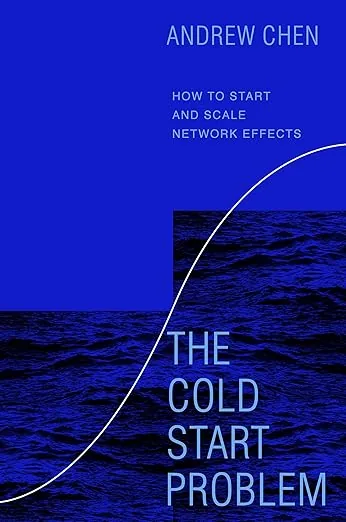
Hooked teaches you to keep users. This one teaches you the harder problem that comes first: how do you get the very first ones when the product is empty and useless?
Andrew Chen ran growth at Uber during the crazy years and is now a partner at a16z, so he’s watched this movie from both the operator and the investor seat. The Cold Start Problem is his framework for products where value depends on other people showing up. Marketplaces, social apps, anything with a network. Nobody joins a dating app with zero people on it, nobody drives for a rideshare app with zero riders. That chicken-and-egg is where most of these startups quietly die.
His answer is to stop trying to boil the ocean and instead nail one tiny “atomic network” that works on its own, then repeat. He walks through tipping points, escape velocity, and how networks eventually hit a ceiling. It’s backed by real stories from Slack, Tinder, Airbnb, and a dozen others.
Fair warning. If your startup doesn’t have network effects (a plain SaaS tool, a content site), a lot of this won’t apply to you and you can skip it. But if you’re building anything two-sided, this is one of the sharpest growth books of the last few years.
Pages: 400
Price: $16.19
Year: 2021
Get on Amazon
Working Backwards: Insights, Stories, and Secrets from Inside Amazon
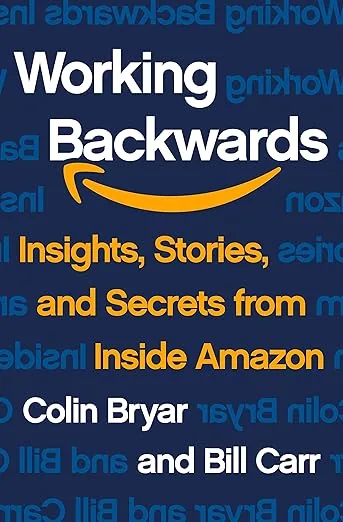
Everyone loves to quote Amazon’s culture. Very few people can tell you how it actually works day to day. Colin Bryar and Bill Carr spent a combined 27 years there, both in the room, and Working Backwards is them opening the hood.
The one idea worth the price of the book is “working backwards” itself. Before you build anything, you write the press release and the FAQ as if the product already shipped. If you can’t make it sound compelling to a customer on one page, you probably shouldn’t build it yet. I’ve used a stripped-down version of this and it kills bad ideas fast, before they eat a quarter of engineering time.
You also get the famous six-page narrative memo (no slides allowed), the “bar raiser” hiring process, and how they think about metrics. It’s the most concrete look at an operating system for a company that I’ve read.
Be honest with yourself, though. Some of this is built for Amazon scale and would be pure theater in a five-person startup. Take the mindset, the PR/FAQ, and the customer obsession. Leave the heavy process until you actually need it.
Pages: 304
Price: $15.79
Year: 2021
Get on Amazon
The Startup Owner’s Manual

Written by Steve Blank and Bob Dorf, The Startup Owner’s Manual is a step-by-step guide for startup ownership, focusing heavily on customer development. This includes helping you identify your audience and discover strategies to help retain and grow your client base as you acquire it.
They detail the customer development process (they’ve used and recommended) to help flesh out your business idea and bring it to life, along with sharing information about “9 deadly sins” that can significantly impair potential success.
This book is a 608-page whopper, but it’s not all text. There are over 100 different graphs, charts, and diagrams, along with 77 checklists that are meant to be immediately actionable and dead useful.
This book has aged well. It’s from 2012, but it’s still extremely current and deserves a spot on our list of the top startup books in 2026!
I remember reading it in 2013 as I was starting AdEspresso, and it was extremely useful back then.
Pages: 608
Price: $24
Year: 2012
Get on Amazon
PS: Amazon lists the book with a 2020 publish date. Just be aware it’s a republishing of the original book; it’s not a second edition with updated content.
The $100 Startup: Reinvent the Way You Make a Living, Do What You Love, and Create a New Future

“The $100 Startup” by Chris Guillebeau, published in 2012, is a guide for aspiring entrepreneurs looking to start and grow a business with minimal investment.
The book is based on numerous interviews and surveys with real startups, and it offers practical insights and case studies to help individuals define and sell a product, as well as grow their business from there.
Guillebeau emphasizes the power of a great idea and the willingness to take action, showcasing examples of people who have successfully started microbusinesses with $100 or less.
The book also delves into the concept of redefining traditional employment and achieving work-life balance. Overall, it provides valuable advice and tools for those seeking to escape the traditional 9-5 job and pursue their entrepreneurial dreams.
While I’d recommend you to secure a bit more funding than $100 in your business plan, this is a book I really enjoyed and a new entry to my best startup books list.
Pages: 274
Price: $4.99
Year: 2012
Get on Amazon
Predictable Revenue: Turn Your Business Into a Sales Machine with the $100 Million Best Practices of Salesforce.com

Predictable Revenue is a book that provides actionable insights for building a high-growth sales team.
It focuses on processes for generating a constant flow of new leads and customers, emphasizing the importance of quality over quantity in sales.
It is a valuable resource for those looking to optimize their salesforce and achieve sustainable business growth. The book covers topics such as creating predictable lead generation, avoiding common sales mistakes, and developing self-managing sales teams
Compared to the other books in this list, Predictable Revenue is less generic and covers a very specific aspect of Startups. It also focuses on B2B SaaS companies with an ACV of at least $5k. That’s the magic number, according to the authors, where a sales team starts to make sense to generate growth. If you’re B2C or not a SaaS startup, you can likely skip this one. If you are in that space, however, this is a must-read!
Pages: 213
Price: $9.99
Year: 2011
Get on Amazon
From Impossible to Inevitable: How SaaS and Other Hyper-Growth Companies Create Predictable Revenue

Aaron Ross and Jason Lemkin’s From Impossible to Inevitable is all about the kind of rapid growth that makes Silicon Valley pay close attention.
Today’s startup founders know better than anyone how much pressure there is to grow at a break-neck speed, scaling to downright aggressive heights, even if you’re struggling to scale as it is.
This book has strategic insights into what you can do to grow faster and more consistently while looking at how companies like SalesForce and HubSpot have already done so. They stress that the growth strategies are just as effective for brands with a $100,000 as they are for brands already raking in $1 billion annually.
Here, you can learn how to identify what roadblocks are slowing your potential growth, discover how to overcome them, create a niche for yourself, and build a strong, highly scalable, and highly effective sales team.
Jason Lemkin is a very successful entrepreneur and venture capitalist. He also created one of the best events for SaaS companies: SaaStr. When it comes to B2B SaaS with a sales motion, he’s one of the smartest guys in Silicon Valley.
Pages: 321
Price: $19
Year: 2021
Get on Amazon
Buy Back Your Time: Get Unstuck, Reclaim Your Freedom, and Build Your Empire

In this book, Martell, a successful SaaS founder himself, shares his own personal journey of overcoming burnout and creating a life with more freedom and flexibility.
The book is divided into three parts: “Get Unstuck,” “Reclaim Your Freedom,” and “Build Your Empire.” In the first part, Martell helps readers identify the reasons for feeling stuck and provides strategies for overcoming obstacles such as fear, procrastination, and feeling overwhelmed. The second part focuses on creating more time in one’s life by prioritizing tasks, delegating responsibilities, and setting boundaries. Finally, in the third part, Martell discusses how to turn that extra time into an opportunity to build a business or pursue other goals.
Founders are probably most hard-pressed on time. There’s so much to do, and so little time. His emphasis on setting boundaries and delegating tasks resonated with me, as those are key strategies that have helped me grow my own business.
Overall, “Buy Back Your Time” is a valuable resource for anyone looking to achieve more in their personal and professional lives and find the right work-life balance… a problem you’ll face sooner than you might expect as a Startup founder.
Pages: 271
Price: $15.99
Year: 2023
Get on Amazon
Co-Intelligence: Living and Working with AI
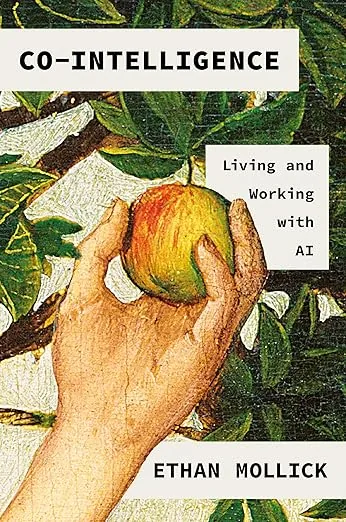
One of the newest books on the list, and honestly a bit of an odd one out. It’s not a startup book in the classic sense. But in 2026 you can’t build a company without thinking hard about AI, so here we are.
Ethan Mollick teaches at Wharton and has spent the last couple of years running everything through these tools in the open, then writing about what actually happens. Co-Intelligence is the least hype-y, most practical thing I’ve read on the subject. His core idea is simple. Treat AI as a coworker, not a magic oracle. Give it a role, keep a human in the loop, and always be the one who checks the work.
For a founder, that framing matters more than any prompt trick. A two-person startup can now do the work of a much bigger team if the founders know how to delegate to these tools. Mollick gives you the mental model for it without pretending the technology is either the apocalypse or the second coming.
I now spend most of my time on exactly this problem, and this is the book I hand to non-technical founders who ask me where to start. It won’t teach you to code, but it will change how you think about what your tiny team can pull off.
Pages: 256
Price: $19.99
Year: 2024
Get on Amazon
Incorruptible: Why Good Companies Go Bad… and How Great Companies Stay Great
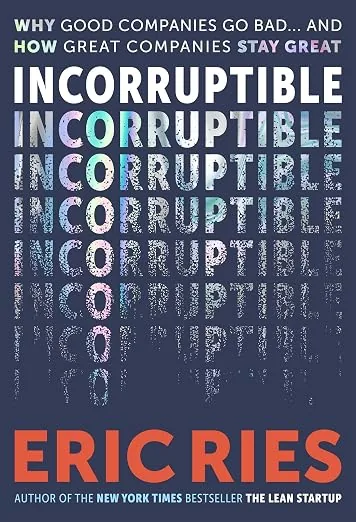
The newest pick here, and a bit of a niche one. It’s from Eric Ries, the same guy who wrote The Lean Startup (yes, also on this list), so when he ships a new book I read it. I’m actually in the middle of it as I write this update.
The premise: why good companies slowly rot as they grow, and what the great ones do to stay honest at scale. It’s packed with stories of companies that lost the plot, plus a framework for building one that doesn’t.
My honest take? It’s a little utopian. Ries is pretty optimistic that small companies can actually pull off this kind of governance, and in practice… I’m not sure how many really will. But that’s not the reason you read it. You read it for the examples: the inspiring ones, and especially the ones that ended badly. There’s a lot of good learning in watching how things go wrong.
Not for everyone, and probably not the first startup book you should pick up. But if you’ve already read the classics and want something that makes you think about the company you’re building for the long run, it’s worth your time.
Pages: 432
Price: $29.00
Year: 2025
Get on Amazon
Want to read most of these books faster?
While I find reading very relaxing, I know sometimes we’re all in a rush. That’s usually even worse for startup founders.
That’s why I tend to read the full edition for books I really care about but rely on book summaries when it comes to books I either find boring (which happens often) or on subjects I care less.
I’ve done an in-depth review (yes, a real review; I subscribed to all of them and tried them all) of the best book summary apps.

I just did a quick check on my favorite app, ShortForm, which has more in-depth summaries, and I’m happy to see that more than half of these books are available on the platform, with new ones added weekly.
Final Thoughts
There’s so much knowledge available today! While not all the advice out there is worth following, these incredible startup books are sources you can trust.
And while this seems like a sizable list, I carefully chose a selection of truly unique startup books that each offered something different.
It’s not going to feel like you’re reading a series of textbooks that never ends; each one is unique, with lessons that can help you accelerate growth at record levels. Some of them are also incredibly enjoyable to read.
Once you’re finished, it could be a good idea to start digging more into leadership and startup marketing. Here’s a list of my favorite marketing books, leadership books, and sales books, and AI books.


January 8, 2023
Hi Ana. I’m the author of an exciting new book for startups and growing businesses and I hope you can include it near the top of your list of best books! • The 7 Secret Keys to Startup Success (Sept. 2022, Skyhorse/Simon & Schuster) is available in hardcopy, eBooks, and audiobooks. You can look inside the book at Amazon.com • It’s the most practical and comprehensive business and legal book for startups and growing businesses. It takes you step-by-step through what to-do and never-to-do to be successful. It’s the one book you need to avoid “Startup Suicide”! • It’s packed with new information on legal requirements you need to know and topics like investing with cryptocurrency; and has model legal and business forms. • It’s an Amazon Best Seller in several business categories and has received rave reviews: o NY Times best-selling author, Byron Dorgan says, “This trailblazing book is packed with the critical business and legal information you need to succeed – and is lots of fun as well!” o Management consultant and former public company CEO, Branko Terzic, calls it, “An instant classic!” • In judging a “best” book, readers can’t learn more from the author than the author knows! So the author’s experience is a key factor in what makes a great startup book. It’s based on my 30+ years of broad and deep experience as a corporate lawyer, inventor, serial CEO, and investor helping hundreds of companies, being an officer of a $1B company, and teaching Law, Business, & Entrepreneurship at Georgetown University.
January 19, 2023
Thanks David, when we'll review the post for 2023 we'll check it out and include in the list if we like it :) We only add books that we read as a general rule for these kind of posts! Max
December 4, 2023
Thanks, I appreciate that! Best, Dave Muchow
Mayank
March 21, 2025
Hey Massimo. You should check out 500 Tips for Startup Folks. It's doing really well and as the name suggests, has 500 Tips for Startup founders as well as employees. Has extremely practical and actionable tips. The book is available on Amazon now. The book has a website www.500tips.com. Hope this helps your readers! :)
Massimo Chieruzzi
July 3, 2026
Thanks for the tip, Mayank — I'll take a look at 500 Tips for Startup Folks. Appreciate you adding it here for other readers.
August 24, 2026
[…] you want more curated reading lists, I keep a few going: the best marketing books, the best startup books, the best personal growth books, and the best book summary apps for when you’re short on […]
August 31, 2026
[…] your problem is more specific to work, my lists of the best startup books, best marketing books, and best AI books will probably get you there […]